


 Gibraltar Federation of Small Businesses


 Gibraltar Federation of Small Businesses

Technology is having a major effect on every aspect of our lives, and the retail environment is not immune to these changes. Not only has online shopping revolutionised the way we think about buying and consuming, but it has also dramatically changed how we shop in physical stores.
Recent surveys into consumer habits show that, although many shoppers now consider online shopping as an option, many also enjoy the experience of shopping in a retail store. For fashion purchases, in particular, customers like to personally examine products for cut and fabric quality and still prefer to try on garments and footwear before they buy.
Technology is being implemented in the retail environment for the following benefits:
Streamlining and automating repetitive processes
Providing information to allow retailers to fine-tune their offerings to customers and, in some cases, personalize the experience
Installing smart digital displays in-store. These not only provide information, as traditional screens did, but can also function as interactive displays, allowing customers to query and communicate with retailers.
With this in mind, I recently visited the Retail Technology Show, held at London’s ultra-modern ExCeL trade centre. Along with trade exhibitors, there were a number of presentations from leading figures in the world of retailing and show business, such as Joe Wicks and Theo Paphitis, who discussed how they had harnessed the power of technology to achieve their goals.
Several technologies were very well represented by exhibitors, including:
– EPOS (Electronic Point of Sale) systems
– RFID technology
– Self-checkout hardware
– In-store digital displays
– AI in virtually every area!
These innovations will, no doubt, become even more prevalent on our high streets in the very near future.
In the face of repeated crises affecting consumer confidence, it is no surprise that a lot of the conversation among visitors focused on how technology could be used to reduce operating costs. However, the mood on the stands was optimistic, with the real emphasis being on how technology can improve the consumer experience, not only through visual graphics but also by freeing up salespeople to spend more time with customers rather than processing transactions.
All our worlds are changing, and so are our requirements and expectations. Despite our 36 years of experience in the market, the team at Marble Arc is still excited to take on the challenges of innovating in order to improve what we do for our customers. Watch this space!


We recently provided a large local organisation with their uniforms. Once the order was delivered, I felt compelled to send them guidelines on how to take care of their uniform. Spending money on clothes and footwear is not a guarantee on making the right impression, either to yourself, nor anyone else- it’s attention to detail that seals the deal.

Imposter syndrome is a psychological behaviour where individuals, including many high achievers, struggle with persistent feelings of self-doubt, inadequacy, or the fear of being exposed as a fraud. Despite their achievements, those experiencing imposter syndrome believe they are undeserving of their success or worry that they've misled others into overestimating their abilities.


Eran Shay's journey is emblematic of the modern entrepreneur. A self-confessed ‘out-of-the-box’ thinker, he swapped a successful corporate career and a senior role at Deloitte to pursue his own projects and business opportunities.
When stakeholder conversations become difficult, most organisations focus on communication. Kerstin Andlaw argues the real issue runs deeper. It is not what we say, but how we stay in the relationship when pressure rises. In complex environments, the ability to work with tension, not avoid it, is what separates transactional engagement from true collaboration.

Pets are like family, right? As a proud cat dad, I’d actually go further and say that they are family. Over the years, I have spent my well-earned money on (many) toys, beds, treats and vet bills for my two feline furballs Nacho and Drake. And I am not alone. According to a recent Fortune Business Insight report, the global pet care market was valued at a massive £171.78 billion in 2022 and is projected to grow from £180.06 billion in 2023 to £269.29 billion by 2030.

Love is big business. According to official statistics, 1,745 weddings took place in Gibraltar in 2021 followed by another 1,761 weddings in 2022 and a further 1640 in 2023. That’s around 33 weddings each week or 6 every single day. With an estimated population of around 33,000, it’s safe to say that, no, we aren’t all marrying each other, but that Gibraltar is a very popular place for many people to come and say ‘I do’. In fact, in all three years, non-residents outnumbered residents by an average of 90% to 10%. The stats point to a healthy wedding sector, one that our Minister for Tourism, Christian Santos is keen to develop. In an interview with the Gibraltar Chronicle he recently said he wanted; “Gibraltar to be the Las Vegas of Europe” when it comes to weddings. Unlike Vegas, we don’t have Elvis. But we do have John. Music legend John Lennon famously married Yoko Ono here in 1969 and put the Rock on the map for ‘Fast Track’ weddings. If music’s not your thing, acting legend Sean Connery (AKA James Bond) also tied the knot here (twice)!

There’s something slightly uncomfortable about sending a contract to a client when you run a small business. Especially in Gibraltar, where relationships matter and business often begins with a conversation over un cafelito rather than a legal document. When you know someone personally, or you’ve been introduced by a mutual contact, it can feel unnecessary to formalise everything. You tell yourself that an email thread is enough. Or that you’ll sort the paperwork later. I used to think like that. Over time, and through a few situations that were more stressful than they needed to be, I’ve realised that putting things in writing isn’t about distrust. It’s about creating guardrails for growth. The clearer the boundaries, the freer you are to focus on doing good work.

Last month marked eight years since the UK voted to leave the European Union. I remember the exact moment I read the headline ‘UK Votes to Leave the EU’ on my phone and the feeling of shock that started to set in. My first thought was, “Er, now what?” Little did I know I would still be asking that question eight years later… Eight years of uncertainty, negotiations, grace periods, frameworks, and meticulously crafted non-statements. But still no solution.

In an age where small businesses must adapt to stay in business, outsourcing has long been a way to enhance efficiency and streamline operations. Derived from the simple philosophy of delegating certain non-core tasks to external experts, outsourcing allows businesses to concentrate on their primary objectives and strengths. For the uninitiated, it's about seeking external expertise for tasks outside your comfort zone, skills base or business's main expertise.

If, like me, you spend more time than you should doom scrolling LinkedIn, you could be tempted into thinking no-one fails. LinkedIn has become a hyperbolic haven and a place to scream and shout about success. But what about failures - why aren’t we talking about them? In business, failure is inevitable. I mean it. Whether it's a product flop, a marketing misstep, or a company on the brink of collapse, every entrepreneur will face moments that test them. Yet, history has shown that these failures can often be the starting point for something extraordinary.

As the CEO of a specialist security business called Paladin Defence and close protection operative/ private security contractor, I have experienced security threats of all types since 1990. From opportunistic personal attacks to targeted organised commercial crime, I feel there is a lot more we should be doing to defend and protect ourselves. Understandably, Gibraltar is considered to have a relatively low crime rate; but what are the realistic threats and risks to small businesses in our corner of the Mediterranean?


If you’ve been dreaming of starting your own business, you’re not alone. Data from the UK’s Office for National Statistics (ONS) revealed that the annual number of companies registered is edging closer to the one million mark, that’s up by 75,000 in 2022 which itself was 30,000 higher than in 2021. Whether it's following a passion, aiming for financial independence, or breaking free from the 9-5 grind, every entrepreneurial journey begins with one crucial thing: a solid idea. But coming up with that perfect idea can be tough. This is where brainstorming comes in—it’s the creative springboard that can help you turn your business dreams into reality.


Since 2007, Earth Hour has been known as the biggest hour for the planet as millions of people switch their “lights off” as a symbolic action for the environment

Starting and running a small business is rewarding but comes with its fair share of challenges. The path of entrepreneurship is often characterised by immense dedication, long hours, and tough decisions. As a small business owner, you're not just responsible for the operations and growth of your company and team, but also for your own wellbeing.

Welcome to the fifth edition of Thrive magazine. Too often the narrative around business focuses on success and, in my view, we forget to talk about failure. That’s why we lead this edition with EPIC FAILS by Katie Buller—because understanding what doesn’t work is just as important as what does.
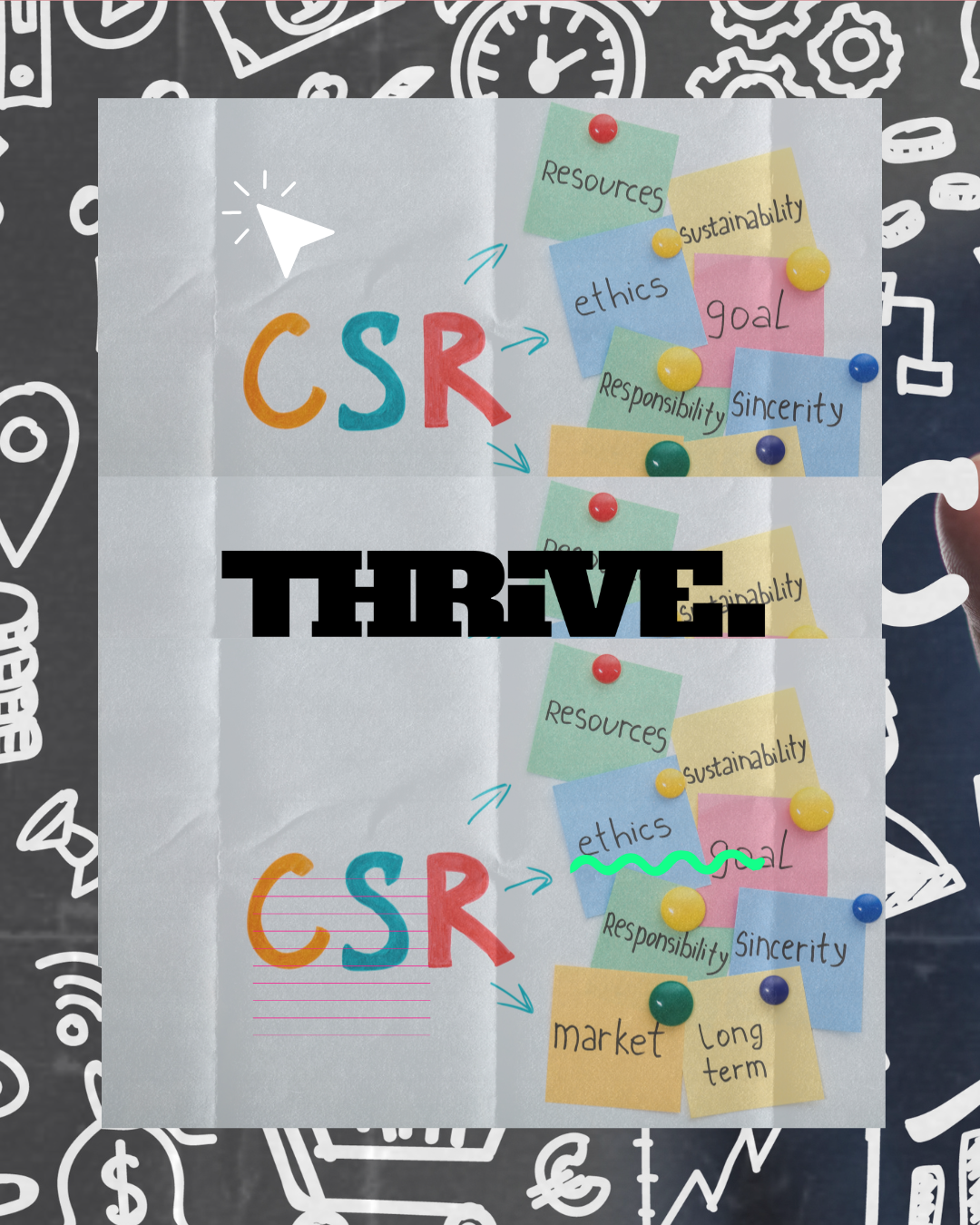
Corporate Social Responsibility is no longer just for big companies. Small and medium-sized businesses are making a real impact through practical, authentic actions that reflect who they are. From supporting sport, culture and charities to rolling up sleeves for environmental projects, consistent CSR builds trust, loyalty and pride. When businesses show up for their community in meaningful ways, those efforts are noticed and often returned.

From the increasing influence of AI to the rise of social commerce and sustainability-driven consumer demand, the key to success lies in adapting strategically rather than chasing every new trend. This guide breaks down the most impactful trends for the year ahead—offering insights on how to integrate them into your business without losing sight of what already works. Smart adaptation, not blind reinvention, is the name of the game. Here's what to expect and how to make it work for you.

Whilst Brexit hasn’t exactly been a positive event, we can’t deny that it’s also been the catalyst for diversification and change. It was a true ‘before and after’ moment that made businesses rethink their strategies and, in many cases, change their direction of travel. Gibraltar’s newest bank, justbank, is born from this process. As well as heralding the arrival of a new bank, this fresh start gave the team at IDT Finance the opportunity to create innovative and tailored banking solutions from the ground up. I met with Managing Director, Damian Asquez, and Head of Corporate Banking, Nikolai Gafan, to find out more.

The Treaty between the EU and the UK over Gibraltar is finally giving us some clarity, and yet, it also reminds us just how much sits outside our control. The finer details will take months to surface. Political tides may shift. Promises will be tested by practicalities. Every day, we face issues beyond our reach: new legislation, competitor actions, market trends, customer behaviour, staff turnover, illness, family responsibilities, global events. All of it lives in what Stephen Covey calls the Circle of Concern - things we care about, but cannot directly change. The more we fixate on them, the more frustration can grow.

AI is poised to reshape the legal profession, with 31% of law firm leaders predicting major disruption by 2025. Scott Simmons explores how AI could improve client outcomes, streamline workflows, and drive value. Whether you’re cautious or curious, it’s time to explore AI’s potential.