

 Gibraltar Federation of Small Businesses


 Gibraltar Federation of Small Businesses

The UK–EU treaty on Gibraltar is finally moving into its most practical and potentially toughest phase. This week brought three clear signals at once: officials quietly discussing how the treaty would work in real life, political approval at Cabinet level, and growing attention on how EU border systems could interact with the treaty timetable
Taken together, they suggest that while ratification is still to come, preparation has already begun.
From negotiation to implementation planning
This week, officials and technical experts from Gibraltar and Spain met at Gibraltar Airport to discuss how the treaty could be implemented once it is ratified, according to reporting by the Gibraltar Chronicle (15 January).
The Government confirmed the meeting in careful terms:
“A team of officials and technical experts from Spain and Gibraltar have today held meetings at Gibraltar Airport. The meetings relate to exploratory discussions for the potential implementation of the arrangements envisaged in the UK/EU Treaty in relation to Gibraltar.”
There were no details, and no fanfare. But the significance lies in the fact that these conversations are happening at all. Attention is beginning to shift from what the treaty says on paper to how it would actually work on the ground.
Treaty text enters its final legal stage
At the same time, Chief Minister Fabian Picardo told Parliament that the treaty text, completed in December, is now undergoing its final technical and legal review, alongside translation.
Importantly, he played down expectations of late changes:
“We’re looking at weeks, not months.”
Once this legal scrub is complete, the formal ratification process can begin in both the UK and the EU, the two parties to the agreement under international law.
How ratification is expected to work
The path ahead is now clearer, even if dates remain open. On the EU side, the European Commission has indicated the treaty should be treated as an EU-only agreement. That would mean ratification in the European Parliament, rather than in the national parliaments of all 27 member states.
On the UK side, the process begins closer to home. The final text will go to the Gibraltar Parliament on an amendable motion, calling on the UK to ratify the treaty. From there, it will proceed through the UK’s CRAG process, where it must sit before Parliament for 21 sitting days.
Mr Picardo stressed that political engagement in Brussels will be crucial:
“It will be important for EU member states and the Commission to persuade a majority in the European Parliament to support the agreement.”
He said Gibraltar will be active in that effort, using Gibraltar House in Brussels and working closely with the UK Mission to the EU to engage MEPs and explain the benefits of the agreement.
Cabinet approval clears a key hurdle
A few days later, on 19 January, No.6 Convent Place confirmed that Gibraltar’s Cabinet has formally approved the treaty text for ratification, subject only to the legal review not changing its meaning.
According to the Gibraltar Chronicle, ministers spent six lengthy sessions reviewing the text in detail with Attorney General Michael Llamas.
Mr Picardo said:
“I am delighted that the Cabinet has given the green light to the ratification of the treaty.”
Once the final text is available, it will be debated in Parliament. The Chief Minister has repeatedly underlined that this scrutiny matters, not just politically, but democratically:
“This is not a debate for Facebook.”
Border systems and the ticking EES clock
Alongside the political process, reporting by Europa Sur highlights an operational reality that continues to loom in the background: the EU’s Entry/Exit System (EES).
Spanish officials from the ministries of Foreign Affairs, Interior and Finance visited La Línea and Gibraltar this week to assess how the EES could be introduced if the treaty is not yet in force.
The system is already being rolled out across the Schengen area and is due to be fully operational by 10 April 2026. While Gibraltar remains a special case, with passport controls on residents currently suspended as a goodwill measure, the infrastructure for EES is already in place at the border.
Europa Sur reports that test operation could begin as early as February if needed.
The reporting also points to unresolved questions that go beyond technology, including:
These are practical details that matter enormously to daily life and business operations, and many remain unanswered.
No deadlines, but growing pressure
When asked whether ratification could be completed before the EES deadline, Mr Picardo avoided setting timelines. He said the priority was to get the agreement right:
“The most important goal was to ensure a deal that was safe and beneficial for Gibraltar.”
At the same time, he acknowledged the need to avoid disruption as EU border systems come into force.
The bottom line
This week marks a clear shift. The treaty is no longer just a negotiated text waiting on signatures. It has political approval in Gibraltar, legal review nearing completion, and officials on both sides already testing how implementation might work in practice.
What remains uncertain is timing and detail. Ratification is still ahead, the interaction with EU border systems is still being worked through, and many of the operational answers businesses and residents need are not yet in the public domain.
What to watch next
As this process enters its most consequential phase, feedback from members on what clarity is still missing will be more important than ever.




Customers now discover businesses through Google, Maps, AI answers and assistants. Learn how to track search visibility and build a practical baseline.
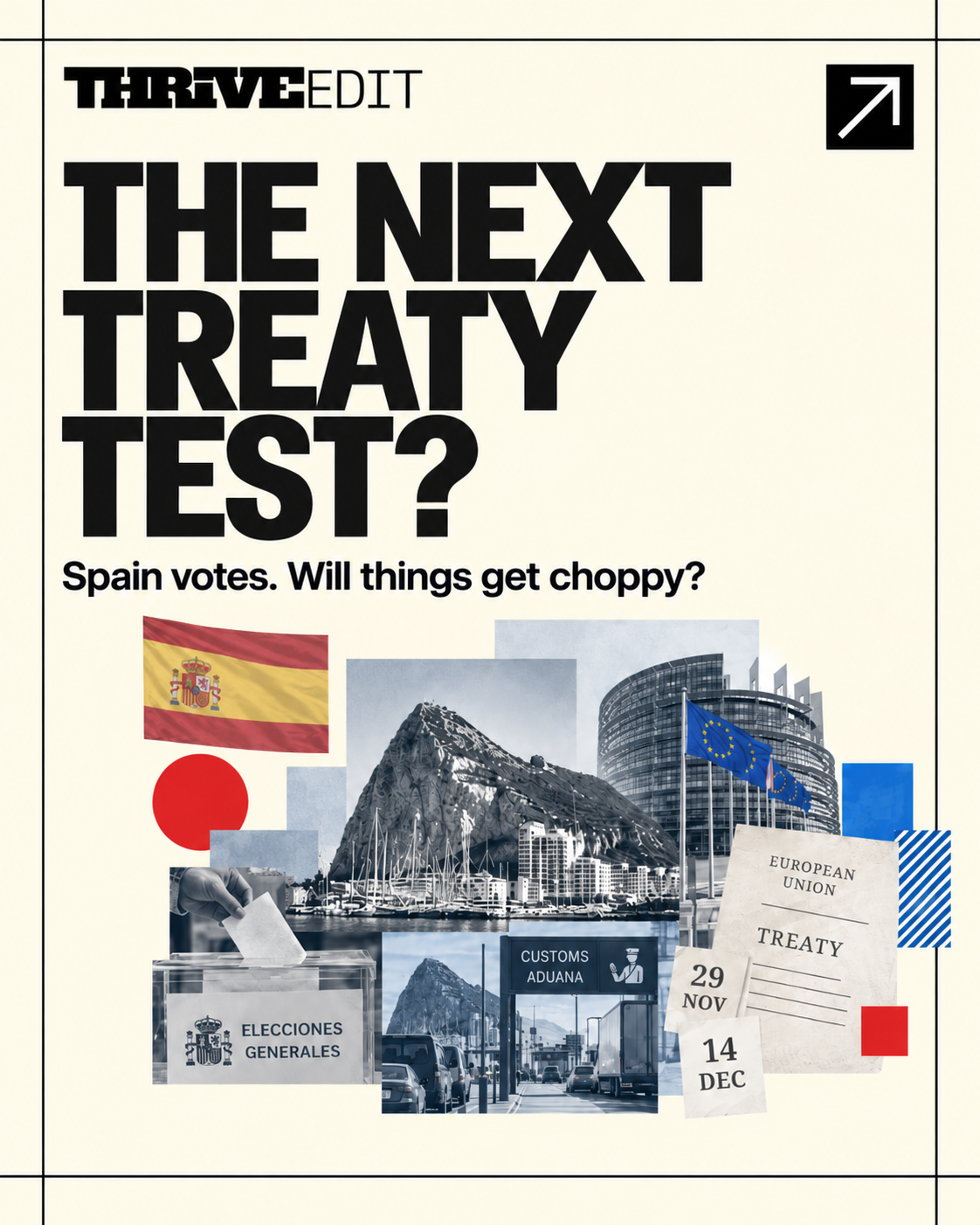
Spain’s snap election lands just weeks before the Gibraltar Treaty reaches its final European ratification stage. With the new arrangements already operating, attention is turning to whether today’s positive cooperation can withstand a change of government in Madrid.

Nearly £8 million in Transaction Tax has been levied since 15 July. With the first 90-day support period ending on 12 October, qualifying businesses are now looking for clarity on how much relief they can access and when they will feel the benefit.

This week’s Do Better Business looks at cost-to-serve, price architecture and how businesses can make sure their pricing reflects the value and complexity built into what they actually deliver.

The frontier is easier to cross, Alcaidesa Marina’s €15m commercial development is taking shape and retailers are adapting to new import costs and changing customer habits. Drawing on recent conversations with Main Street businesses and our interview with Gemma Arias-Vasquez and Louis Montegriffo, we look at where Gibraltar retail goes next.