
 Gibraltar Federation of Small Businesses


 Gibraltar Federation of Small Businesses


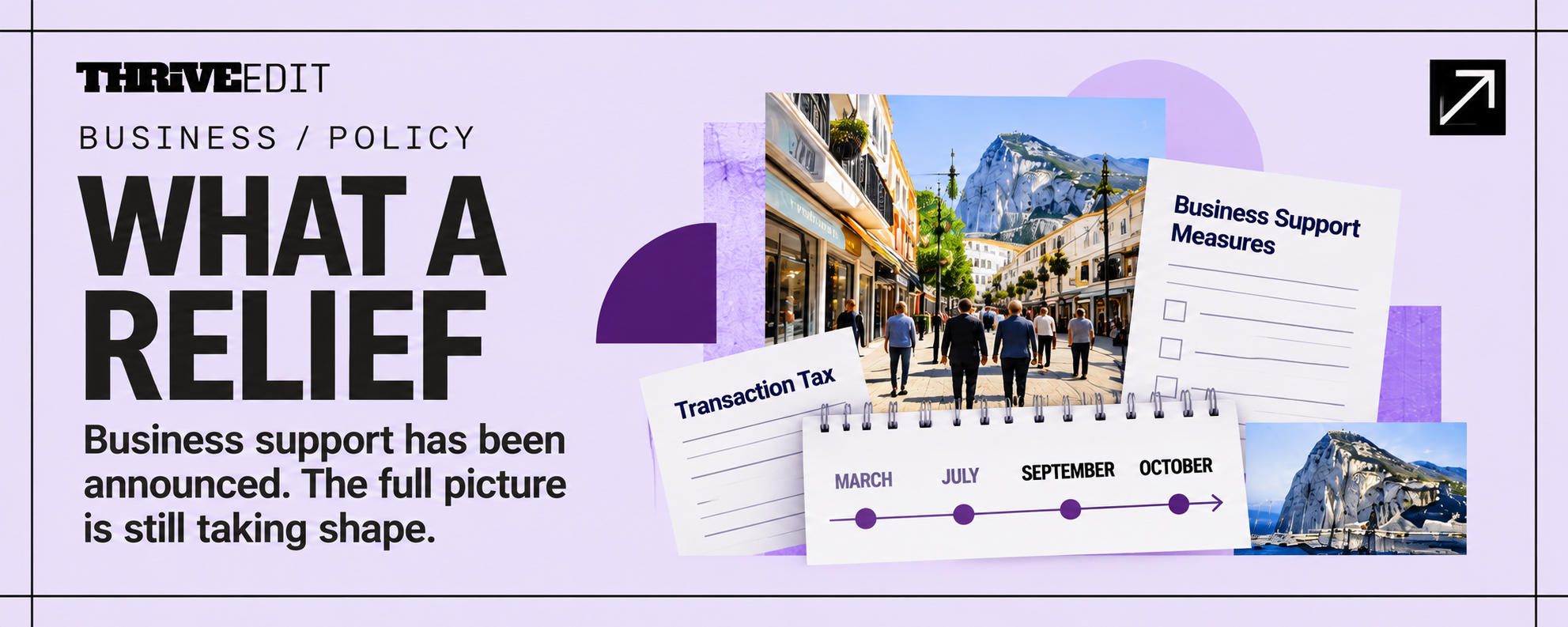
In March this year, the Chief Minister announced a package designed to cushion retail and wholesale businesses from some of the immediate effects of the move from Import Duty to Transaction Tax. It included a temporary tax deduction for businesses facing higher costs, additional business rates relief, a 36-month waiver of vacancy registration fees and a 24-month moratorium on rent increases for qualifying retail and wholesale premises.
At the time, these measures were understandably welcomed. Businesses had warned that the new trading arrangements could raise costs considerably for some operators, and the GFSB had already argued that direct financial support might be needed alongside practical guidance.
As implementation approached in June, Government signalled that further business support would follow. Minister for Business Gemma Arias-Vasquez told the GFSB Annual Dinner that the Chief Minister would make further announcements during the Budget debate, alongside ongoing work on State Aid compliance and Treaty implementation.
Those announcements eventually came in July, when the Minister set out two alternative schemes for businesses particularly exposed to the new trading environment.
The first was the Transaction Tax Transition Support Scheme, building on the deduction announced in March. The second was the Business Impact Adaptation and Modernisation Support Scheme, intended to help retail and hospitality businesses invest in areas such as premises, technology, processes, consultancy, innovation and staff training. Businesses would have to choose between the two rather than receive support from both.
Three months into the new Treaty environment, businesses now have considerably more experience of how the changes are affecting them. What they still lack is the complete support framework they were told would accompany that transition.
The clearest progress came on 23 September, when Government published the Transaction Tax (Deductions) Rules 2026.
These finally put legal detail behind the Transaction Tax relief. Eligible retail and wholesale businesses can claim a deduction against assessable profits based on the difference between the Transaction Tax paid during the first 90 days and the Import Duty that would previously have applied, where Transaction Tax is higher. The deduction is capped at 50% of the tax paid in the preceding accounting period or year of assessment.
That gave businesses something concrete to work with, although it arrived much later than many had hoped. The July Budget expected further guidance on the Transaction Tax scheme the following month. The Rules were ultimately published on 23 September, just weeks before the initial 90-day support period ended on 12 October.
The relief also works differently. This is not a cash refund of the additional Transaction Tax paid at the frontier. It is a deduction against assessable profits, meaning the financial benefit may not be felt immediately. For a business already dealing with higher import costs and cash-flow pressure, timing is key to understanding how useful the relief will be.
The GFSB’s own guidance has therefore encouraged businesses to quantify the potential Transaction Tax deduction while also considering whether the alternative modernisation support could ultimately offer greater value. That comparison is difficult to make when only one side has been published.
The second scheme could be particularly significant for businesses trying to adapt to the new environment.
When it was announced, the Business Impact Adaptation and Modernisation Support Scheme was described as a way to share the cost of improvements, including digital systems, staff training, consultancy, process improvement, innovation and premises upgrades.
For some businesses, a contribution towards modernisation may be more useful than a future tax deduction. A retailer considering new technology, a hospitality operator reviewing its premises, or a business investing in staff development needs to know what expenditure might qualify, how much support could be available, and when to apply. Those details have still not been published.
On 23 September, Government said it would publish the modernisation scheme “in the near future”. Two days later, the Business Transition Advisory Group was told that further support measures would follow “in the coming weeks”. As of 26 October, Government’s published material still does not set out the final eligibility rules, funding limits, qualifying expenditure or application process for that scheme.
That leaves businesses asked to choose between two forms of relief without being able to compare them properly.
The modernisation scheme is not the only part of the original support package where businesses would benefit from a clearer picture.
The March announcement also covered rates relief, vacancy registration fees and a moratorium on rent increases. By July, the Minister said regulations covering rates relief and the rent moratorium would follow shortly, and that the rates measure would also extend to restaurants.
There has been movement since then. In Parliament earlier this month, the Minister said quarterly rates invoices would reflect the measures announced in her Budget. But businesses trying to understand the complete package still have to piece information together from parliamentary statements, Budget announcements, individual legal notices and subsequent press releases.
Government has published substantial Treaty guidance in other areas, including detailed FAQs, customs notices and sector-specific information. What remains missing on business relief is a similarly clear, practical, consolidated guide that sets out what is available, who qualifies, how each measure works, what businesses need to submit, and when they can realistically expect the benefit.
That would also make it easier to understand how the different measures interact. Businesses should not need to reconstruct a support package announced over several months before they can decide whether it applies to them.
These measures were meant to help businesses through a major structural change in how Gibraltar trades.
That change is no longer theoretical. Transaction Tax has been operating since 15 July. Businesses have now been importing under the new system for more than three months, absorbing new administrative requirements and working out what those changes mean for prices, margins and cash flow.
The initial Transaction Tax support period has already ended, although the Rules allow an independent committee to recommend extending it in further 90-day periods. Government has also said it will continue monitoring the impact through the Business Transition Advisory Group.
The GFSB has consistently supported constructive engagement with Government on Treaty implementation, and publishing the Transaction Tax Rules was an important step forward. The concern now is that the rest of the support framework needs to catch up with the reality businesses are already experiencing.
Businesses need the modernisation scheme published. They need clear confirmation of how the rates, rent and other relief measures operate. They need practical guidance on application routes, documentation and timescales. And where decisions are still being made, they need realistic dates for when those decisions will be completed.
Support is most valuable when a business can factor it into a decision. Three months into the Treaty era, Gibraltar’s affected businesses should be able to see the full package, understand what they qualify for, and choose the support that works best for them. That would provide some much-needed relief.




The Festival of Lights falls exactly one week before Black Friday. With the frontier easier to cross and Gibraltar potentially accessible to a much wider Costa audience, could one of the busiest nights of the year become the start of a stronger Q4 for local business?

Gibraltar businesses are reaching new audiences in London and across the frontier. Here’s how to prepare your proposition, capacity and partnerships for growth.
A new aquarium at Rosia Bay could add to Gibraltar’s tourism offer. We look at the wider business opportunity and the questions still to be answered.
Governments and geopolitical strategists use simulations to test what might happen when other players react. The same thinking can help businesses challenge assumptions, anticipate competitors and prepare for decisions before real money is on the line.
From Hong Kong to Abu Dhabi, Gibraltar is pursuing new industries and investors as part of a major economic diversification drive. Minister Nigel Feetham says the campaign is already generating business. The bigger question is how far those opportunities can spread through Gibraltar’s wider economy.