

 Gibraltar Federation of Small Businesses


 Gibraltar Federation of Small Businesses

This week’s budget addresses have been lengthy and detailed, but there has been a lot of politicking too. Here, we strip away the banter, and break down what we think businesses need to know, and the issues they need to think about.
Key business takeaways
This Budget is being framed by Government as the start of a new Treaty-era economy. For businesses, the more immediate reality is much less romantic.
The opportunities presented by the Treaty may turn out to be big in the long term. In the short term, the question for many small businesses is simpler: can existing margins absorb these costs?
The bigger picture
Gibraltar is moving from the old Import Duty model into a new Transaction Tax environment. The Chief Minister said new rules on Transaction Tax and European Excise Duties will take effect from 15 July, with business support measures also starting from that date.
Government is presenting this as the operational beginning of a new Treaty economy: more fluidity at the frontier, stronger international alignment, future aviation opportunities and a more modern trading framework.
In short, Treaty is about pricing, payroll, compliance, imports, systems, cashflow and customer behaviour. The same Budget that promises opportunity also introduces or confirms several pressures that hit the operating base of local firms.
The cost stack
The Budget creates a familiar small-business problem: no single measure may be fatal on its own, but several arriving together can materially affect margins.
Businesses now have to factor in:
Minimum wage: the £1,000 question
The minimum wage increase is one of the clearest direct cost increases in the Budget.
The minimum wage will increase from £9.50 to £10 per hour. The move from £9.50 to £10 per hour represents a 5.26% increase. On a 37.5-hour week, annual earnings rise from £18,525 to £19,500. On a 39-hour week, they rise from £19,266 to £20,280.
For a full-time employee on minimum wage, that adds £975 per year on a 37.5-hour week, or £1,014 per year on a 39-hour week, before any pension, overtime, holiday pay or knock-on wage effects are considered.
There has not been an announced increase in social insurance rates. That distinction matters. Current social insurance contributions are earnings-related but subject to minimum and maximum weekly amounts, with employer contributions calculated at 18% of gross earnings subject to a weekly cap. (Government of Gibraltar)
For a full-time minimum wage employee, the employer is already above the weekly contribution cap both before and after the rise from £9.50 to £10. So the minimum wage rise does not appear to increase employer social insurance for those full-time workers on current published rates. For part-time employees below the cap, the position may be different.
The clearer business impact is the direct wage increase, plus any payroll-linked costs such as private sector pension contributions, where applicable. Employers and employees are generally required to contribute a minimum of 2% of gross earnings each under Gibraltar’s private sector pensions regime.
Business impact
For workers, this is a meaningful uplift.
For employers, especially in retail, hospitality, cleaning, care, security and other labour-intensive sectors, it is a direct increase in the wage bill.
For a business with ten full-time employees on minimum wage, the additional basic wage cost alone could be close to £10,000 a year.
That does not include any pension impact, overtime, holiday pay or pressure to maintain pay differentials between junior and more experienced staff.
Private sector pensions add to the cost base
The minimum wage rise may also affect workplace pension contributions where those contributions are calculated as a percentage of gross earnings.
Under Gibraltar’s private sector pensions regime, both employer and employee contributions are generally required, with a statutory minimum contribution of 2% of gross earnings from each party unless the employer pays more and covers the employee’s minimum requirement.
Business impact
On a £975 annual wage increase, a 2% employer pension contribution adds £19.50 per year per eligible employee.
That may sound modest in isolation. Across a larger workforce, and alongside the wage increase itself, it adds to the cumulative cost.
Transaction Tax begins
The new Transaction Tax regime starts on 15 July.
Import Duty is estimated to raise just £20 million this year, reflecting only the three months before Treaty implementation. Transaction Tax is expected to raise £80 million for the rest of the year. The rate starts at 15%, rises to 16% next year and is expected to settle at no lower than the lowest VAT rate in the EU, currently 17%, from year three.
Business impact
This is a major structural change for businesses that import, distribute or sell goods.
Retailers, wholesalers, importers and hospitality operators will need to understand how the new system affects landed costs, pricing, margins, invoices, accounting systems and cashflow.
The change may be manageable for some businesses. For others, especially those with tight margins and high import volumes, the impact may be more difficult.
Support Measures
Two support schemes were announced – although one of them appears to “ extend the measure the Chief Minister previously announced as the Transaction Tax Deduction”. Businesses can apply to one scheme only, and relief is capped at “no more than 50% of the corporate tax profits paid by the business in the previous tax year(s)”.
1: TRANSACTION TAX TRANSITION SUPPORT SCHEME
This is aimed at businesses that can show they are materially worse off under Transaction Tax than they would have been under the former Import Duty regime during the first year of application.
The scheme will compare what a business would have paid under Import Duty with what it has actually paid under Transaction Tax. It is not intended to remove Transaction Tax, undermine the new system or provide blanket support. It is targeted at businesses that can demonstrate genuine disadvantage.
The assessment will be retrospective at the end of the first 90 days, once the real impact can be measured. Government will meet every three months with the GFSB, Chamber, Customs and the Department of Business to review the measure and decide whether it can be extended beyond the initial period.
Precisely what can be claimed under this measure, is not clear. Further guidance is expected next month, and anti-avoidance measures will be introduced.
2: BUSINESS IMPACT ADAPTATION AND MODERNISATION SUPPORT
This a targeted scheme intended to help businesses invest in themselves and adapt to the new trading environment.
The Minister for Business said this support may cover areas such as modernisation, process improvement, consultancy, innovation, staff training, digital systems and practical measures that help businesses become more competitive.
The scheme will be funded directly by Government, designed within the relevant State Aid framework and targeted at the sectors most affected by the transition, particularly retail and hospitality. Applications will be considered through a proper process, with business representation included in the assessment structure.
Business impact
This is probably the most significant treaty related announcement for small businesses if the scheme is accessible and practical. But there was little detail in the budget address “the detail of the scheme, including the application process, eligibility criteria and supporting documentation required, will be published in due course”.
Many firms do not only need help with the Transaction Tax implementatio. They need better systems, better data, better stock control, better training and better ways to understand margins. Direct financial assistance to facilitate this change and innovation would be most welcome.
The question is how the application process will be and how quickly support can reach the businesses that need it most.
Rates and rent relief
The Minister for Business also confirmed that measures relating to rates relief will be extended to the restaurant sector in the same way as retail. Details for rates relief and the moratorium on rent increases are expected in regulations to be published shortly.
However, there are limits. Businesses will be able to apply for only one of the available schemes. Neither scheme will apply to supermarkets, tobacco, wine, spirits, fuel or vehicle retailers. Applicants must be up to date with PAYE, social insurance, corporate tax and filing requirements. Support will also be capped, including by reference to corporate tax profits paid and State Aid and Treaty rules.
Business impact
Compliance is now part of access to support. Businesses that are behind on filings or payments may find themselves excluded from assistance. For small businesses, the practical message is clear: keep records, tax, PAYE and social insurance up to date.
Public sector pay raises the benchmark
The Budget also sets out a major public sector pay settlement. Government accepts a 12.6% loss of public sector purchasing power between August 2019 and 2025 and will recover that over five years. The framework includes annual recovery increments of 2.5%, inflation-linked increases and a longer ten-year structure. The minimum entry salary across the public service will rise to £24,413 per annum.
Business impact
This matters because Government is one of the strongest competitors for staff in Gibraltar. If public sector pay, pension security, annual leave and job stability improve, private employers may face more pressure to compete. Many small businesses will not be able to match public sector terms. That makes retention, culture, flexibility and progression even more important.
Residency remains a business issue
The Minister for Business made clear that Gibraltar still needs skills, workers, entrepreneurs and investors from outside. The new residency framework is not intended to stop businesses recruiting people to work in Gibraltar, but to determine when residence in Gibraltar should follow.
Business impact
Many businesses rely on cross-frontier workers, non-resident labour and specialist recruitment. The practical test will be whether the new system gives employers enough flexibility, speed and certainty.
See the article from the previous edition of Thrive EDIT for more detail on this issue.
A new Business Act is coming
Consultation with the GFSB and Chamber on a new Business Act will continue until the end of September.
The aim is to modernise business licensing and registration, simplify processes, improve interdepartmental cooperation and strengthen enforcement.
Business impact
This could help compliant businesses if it reduces duplication and speeds up applications.It also signals more enforcement against unregistered or non-compliant operators. For businesses playing by the rules, that should be welcome. For informal operators, the direction is clear.
Vehicles get specific treatment
Transaction Tax on vehicles will be charged at the standard rate, starting at 15%, rather than the higher rates payable to date. There will be no difference between an individual or entity making the importation. EU rules on vehicle imports and fleets will apply, and compulsory electrification dates move to 2045.
Business impact
Vehicle retailers and fleet operators have some clarity on the standard rate, but will still need to manage pricing, ordering, stock timing and customer advice carefully.
Tobacco becomes more controlled
Tobacco will move to a new differential of 80 euro cents per packet, or €8 per carton. Each band of tobacco will be no more than 15%, or around 80 cents, cheaper in Gibraltar than in Spain.
Excise will vary by cigarette category, and Transaction Tax at 15% will be levied on cost, insurance, freight and excise. The quarterly Gazette will adjust prices if Spanish prices or exchange rates change.
Nicotine pouches and snus will also be banned, and legislation will be introduced to restrict tobacco and tobacco-related sales to locally resident individuals born after 2009.
Business impact
Tobacco retailers face one of the most technical parts of the Treaty transition. This is a tax, pricing and compliance issue all at once.
Aviation could bring upside
The Chief Minister said the Treaty will immediately allow flights from the rest of the EU and Schengen destinations, lifting the Spanish veto on wider European routes.
Business impact
This is one of the more positive long-term possibilities.
More air routes could support tourism, hospitality, events, retail, property, professional services and inward investment. But opportunity will not automatically convert into revenue. Local businesses will need to market, package and sell Gibraltar well if new routes materialise.
Spain blacklist removal helps reputation
The Chief Minister highlighted Gibraltar’s removal from Spain’s tax blacklist after 35 years.
He said the designation had cost businesses, complicated life for cross-frontier workers and damaged Gibraltar’s reputation. He also said removal benefits local businesses transacting in Spain and cross-frontier workers resident in Spain.
Business impact
This is reputationally important for Gibraltar as a finance and business jurisdiction. For firms with Spanish connections, it may also reduce friction and improve confidence.
The bottom line
The Budget offers businesses support, but it also adds pressure.
The Government’s argument is that Gibraltar is entering a new Treaty era with greater opportunity, better frontier fluidity and a stronger international position.
For small businesses, the immediate calculation is more direct.
Can they absorb around £1,000 more per year for each full-time minimum wage employee?
Can they manage any pension-linked payroll increases?
Can they adapt to Transaction Tax without damaging margins?
Can they stay compliant enough to access support?
Can they compete with public sector pay?
Can they modernise quickly enough to protect profitability?
This is the real business test of the Budget.
The Treaty era may open the door to growth. But for many local firms, the first challenge is getting through the transition without losing control of costs.


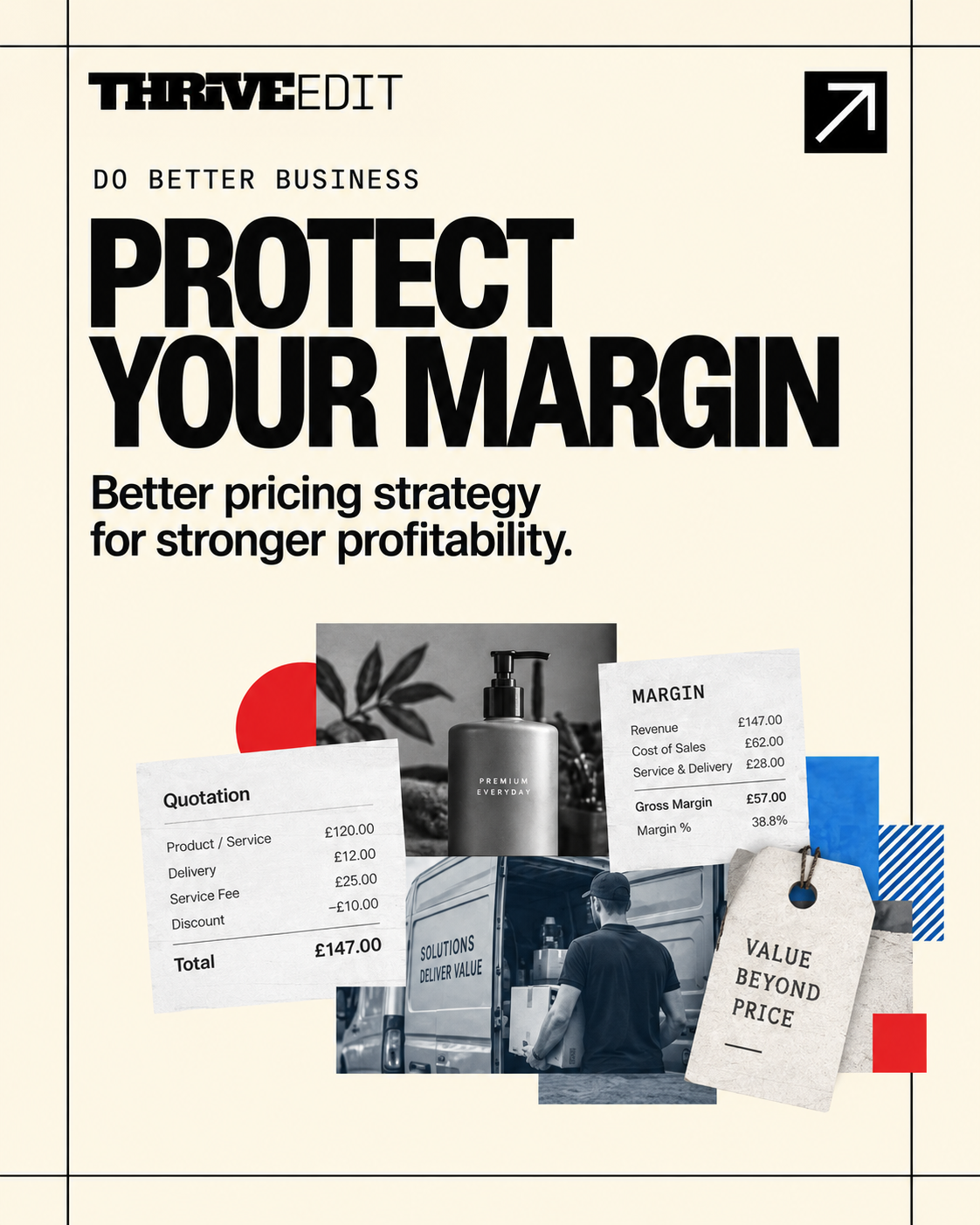

This week’s Do Better Business looks at cost-to-serve, price architecture and how businesses can make sure their pricing reflects the value and complexity built into what they actually deliver.

The frontier is easier to cross, Alcaidesa Marina’s €15m commercial development is taking shape and retailers are adapting to new import costs and changing customer habits. Drawing on recent conversations with Main Street businesses and our interview with Gemma Arias-Vasquez and Louis Montegriffo, we look at where Gibraltar retail goes next.

Algeciras and Tarifa are developing cruise offers of their own. Gibraltar remains the Bay’s established port of call, but a more ambitious regional tourism market makes the quality of each visitor’s experience here increasingly important. Thrive Editor, David Revagliatte explores what this could mean for local businesses. Gibraltar expects around 260 cruise calls in 2026. […]

New rules give eligible retailers and wholesalers a route to tax relief on some of the additional Transaction Tax incurred during the first 90 days of Treaty implementation. The detail is important, including who qualifies, how the deduction is calculated and the choice businesses will need to make between this measure and forthcoming modernisation support. […]

Last week’s GFSB Summer Party brought members together for an evening of conversation, new connections and a chance to reconnect ahead of Q4. With thanks to justbank and Capurro Insurance for supporting the event, we’ve pulled together some of our favourite photos from the night.