

 Gibraltar Federation of Small Businesses


 Gibraltar Federation of Small Businesses

The Government has confirmed to the Brexit Transition Advisory Group (BTAG) yesterday that the expected date for the entry into force of the UK-EU treaty in relation to Gibraltar is 10 April 2026.
This is the date for the full entry into force of the European Electronic Entry System (EES). The entry into force of the treaty on that same date eliminates the risk that the Gibraltar frontier comes to an effective standstill on that date. Whilst this timeline remains subject to change, all parties to the treaty are currently working towards the 10 April 2026 implementation date. It represents a significant advancement on previously indicated timelines for the treaty’s application.
During the meeting, the Government outlined key elements of the treaty and the practical implications for businesses, particularly in relation to goods, customs, taxation, and transitional arrangements.
The treaty text has not yet been published but the legal scrub has been completed and the text will soon be circulated by the European Commission to the EU Council (member states). Publication is expected within a period of weeks.
Overview of the Treaty Framework
The briefing to BTAG focused on trade related matters, not on movement of people, but it was confirmed that the aim is to implement movement of people by 10 April 2026 as well.
The BTAG group were informed that the treaty is extensive, comprising over 330 articles and, including annexes and protocols, running to just under 700 pages. A substantial portion of the text relates to goods, customs procedures, and indirect taxation.
At its core, the treaty establishes a customs union between Gibraltar and the European Union, removing customs duties on goods moving between the two. Provisions mirroring standard EU rules on the free movement of goods, customs processes, and the prevention of unfair trading practices will apply.
Separate regimes are provided for the import and export of EU goods and non-EU goods, with detailed provisions set out in annexes. Indirect taxation measures cover transaction tax and excise duties, alongside the creation of an independent body to monitor market competitiveness, particularly between Gibraltar and neighbouring Campo de Gibraltar.
Placing Goods on the Market
Under the treaty, EU standards will become the norm for goods placed on the market in Gibraltar. Licensing requirements and compliance procedures were outlined, with customs authorities in Gibraltar and Spain expected to work jointly on enforcement.
Transitional Arrangements
The Government confirmed that transitional arrangements will apply from the date of entry into force:
Goods already on sale in Gibraltar: Non-EU-compliant goods already on shelves at the point of implementation may continue to be sold for a period of three months.The Government acknowledged that these timeframes are challenging but confirmed that they reflect the constraints of the wider EU implementation timetable, particularly the introduction of EES. Any delay to EES may result in a corresponding delay to the treaty’s application.
Goods already in transit: Goods that have left their place of origin before 10 April 2026 will not need to comply immediately with the new regime, provided they arrive within a two-month window.
Goods covered by certificates of exemption: Certain projects of social or economic importance will benefit from limited transitional relief, subject to defined time limits and ongoing administrative oversight.
Taxation and Cost of Living Measures
A standard rate of transaction tax of 15% will apply upon the entry into force of the treaty. Subject to assessments to be made by the independent body, this will increase to a level equivalent to the lowest standard VAT rate applied by any EU Member State (currently, 17%). Reduced and zero rates of transaction tax will apply to a range of essential goods, mirroring the EU VAT framework. These include a zero rate of transaction tax on foodstuffs, water, pharmaceuticals, medical equipment, and a 5% transaction tax on children’s clothing and footwear, and certain agricultural products. These measures are intended to mitigate impacts on the cost of living.
Excise duties on tobacco, alcohol, and fuel will move towards EU minimum levels, with phased implementation in certain areas. Personal allowances for travellers will apply during an initial transitional period before moving away from an allowances regime restrictions after three years.
Looking Ahead
The Government emphasised that, while the treaty represents a significant logistical and regulatory change, it also provides long-term certainty and avoids the alternative scenario of no agreement. Operational processes are expected to become smoother over time as confidence and familiarity with the new systems develop.
The Gibraltar Federation of Small Businesses (GFSB) remains on hand to inform and assist its members throughout this transition period. The GFSB will be convening meetings for its membership to discuss their views, share concerns, and formulate further questions for Government as implementation progresses.




Governments and geopolitical strategists use simulations to test what might happen when other players react. The same thinking can help businesses challenge assumptions, anticipate competitors and prepare for decisions before real money is on the line.

From Hong Kong to Abu Dhabi, Gibraltar is pursuing new industries and investors as part of a major economic diversification drive. Minister Nigel Feetham says the campaign is already generating business. The bigger question is how far those opportunities can spread through Gibraltar’s wider economy.

Gibraltar plans a new residency route for financially independent over-55s alongside a new business think tank announced at GibLink London.

New frontier lanes and discussions around a cross-border transport interchange raise questions about buses, workers, visitors and business connectivity.
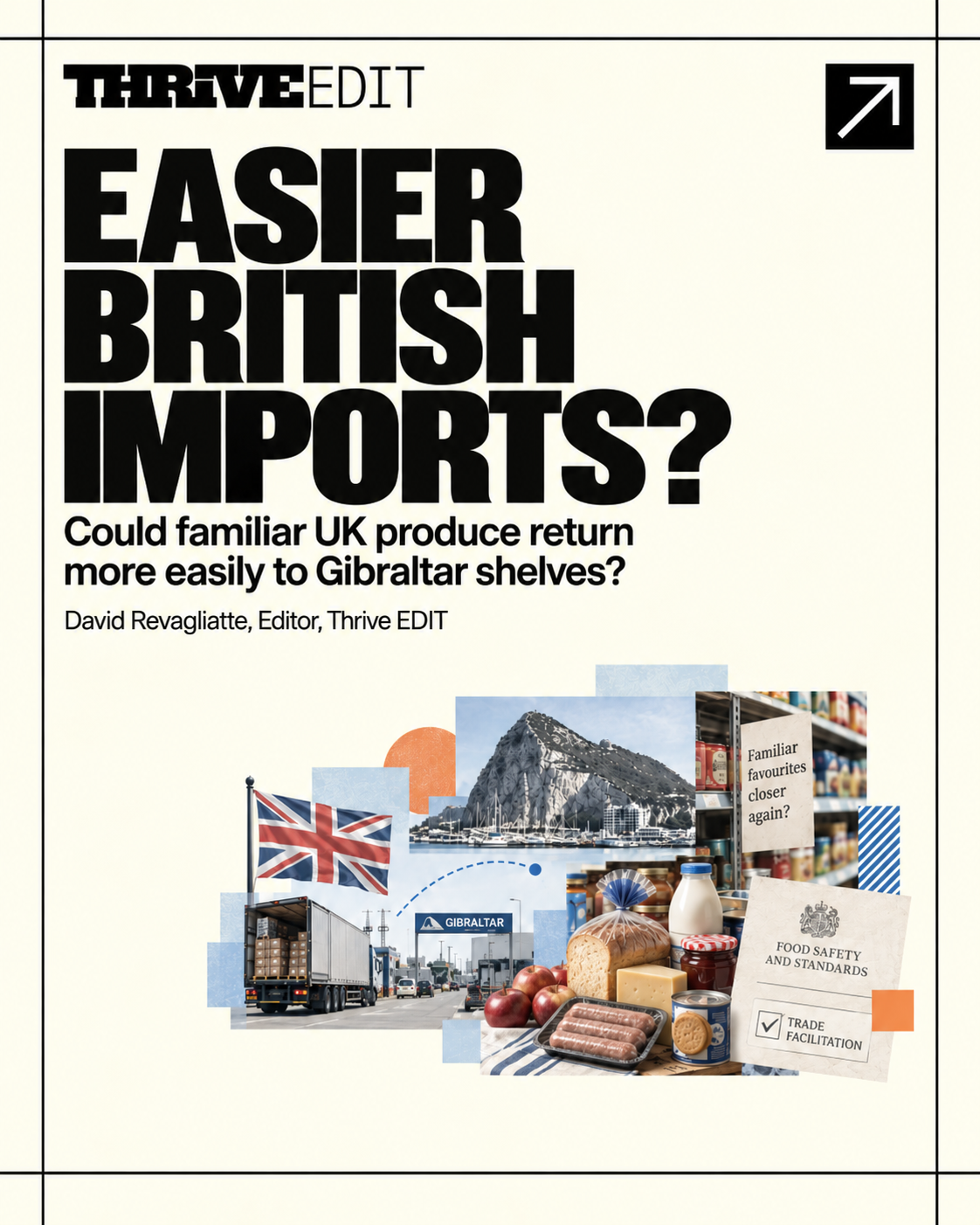
Could a future UK-EU food agreement make it easier for British produce to return to Gibraltar shelves? British produce has long been part of Gibraltar’s shopping experience; I wrote about it a couple of years ago, before we had a Treaty in place. From supermarket staples and fresh food to familiar household brands, we’ve spent […]