
 Gibraltar Federation of Small Businesses


 Gibraltar Federation of Small Businesses

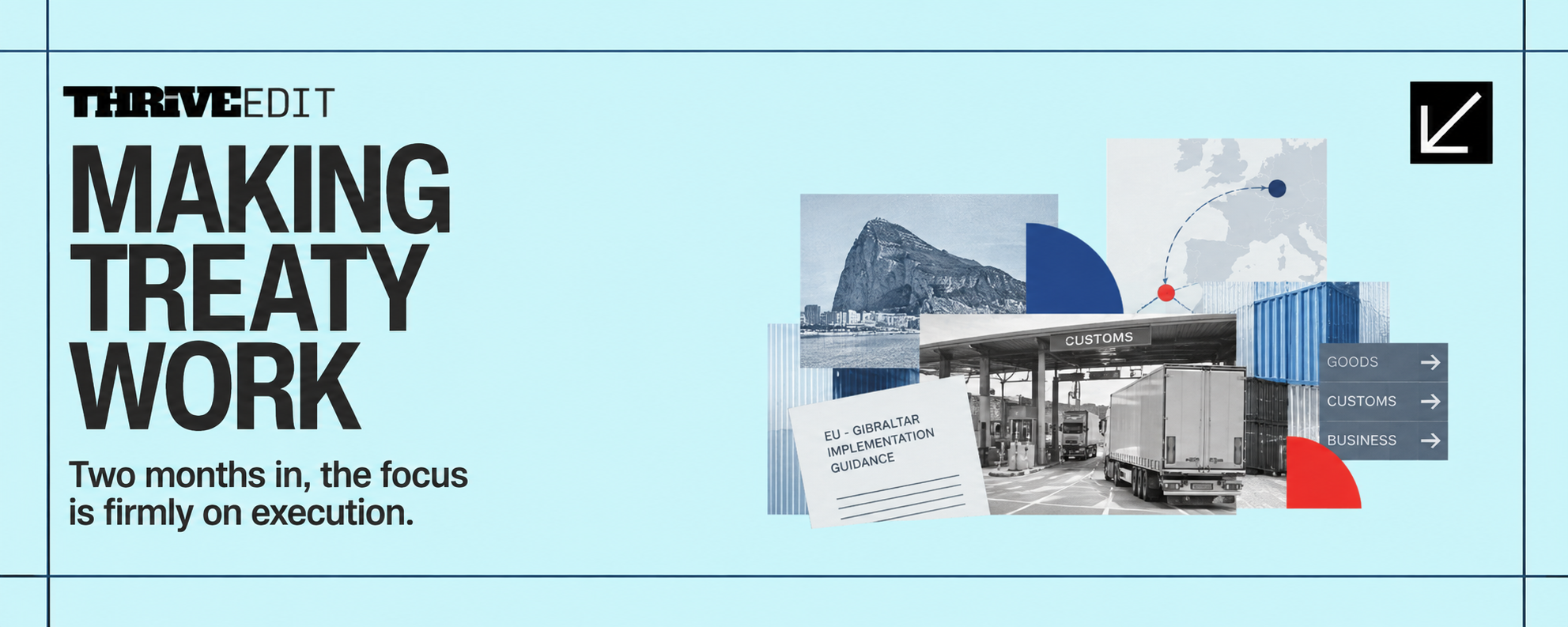
Two months into Gibraltar’s new Treaty arrangements, the focus has shifted from negotiation to execution. Customs remains the main pressure point, but the early picture is of a system being tested, adjusted and gradually embedded while businesses and officials work through the detail.
For almost five years, Gibraltar’s Treaty conversation was dominated by negotiation. Since provisional implementation began on 15 July, the questions have become more practical.
Can goods move efficiently? Are Gibraltar and Spain applying the rules consistently? What happens when a consignment does not fit neatly into the published guidance? Who resolves the problem when an unusual case reaches the frontier?
Those are the questions businesses are now asking, alongside a wider concern about how durable the arrangements will be if political leadership changes in either Spain or the United Kingdom.
In an interview published this week by the Gibraltar Chronicle, Attorney General Michael Llamas, Gibraltar’s chief negotiator throughout the process, described the current position as “calm” but “relentless”. The initial intensity has eased, but officials continue to deal with a steady stream of practical issues arising from a system Gibraltar has never operated before.
He also pointed to the political uncertainty surrounding future changes of Government in Madrid and London. The Treaty is designed to provide a durable framework, but its operation will depend on continued political commitment and effective cooperation between the administrations responsible for applying it.
Businesses cannot ignore that consideration. A change of Government does not automatically undo an international agreement, but it can affect priorities, interpretation, administrative relationships and the speed at which unresolved issues are addressed. Once again, the road ahead seems uncertain.
Customs is generating the greatest workload. A Treaty framework has to accommodate thousands of different products, journeys and commercial circumstances. The questions emerging range from conventional freight to highly specific cases involving blood samples, commercial laundry and other consignments that do not fit easily into standard procedures.
For businesses, this is where the Treaty’s success will increasingly be judged.
The most encouraging development is that the machinery for resolving problems appears to be functioning.
Gibraltar Customs and its counterparts in La Línea are now in regular contact, with Llamas describing cooperation between the two offices as excellent and taking place daily. Gibraltar’s draft customs guidance has also been shared with Spain’s Agencia Tributaria to ensure both sides interpret the new arrangements consistently.
That level of contact is essential during the early stages of implementation. No guidance document can anticipate every product, route or commercial arrangement. The practical test is whether an issue can be identified quickly, referred to the right officials and resolved without becoming a recurring obstacle.
The Treaty provides the legal framework. Day-to-day cooperation determines how smoothly that framework works for a retailer waiting for stock, a wholesaler importing goods or a company trying to establish which procedure applies to a particular shipment.
Government has continued to issue technical guidance covering transit, special customs procedures, transaction tax, labelling, cross-border deliveries and product compliance. The guidance is becoming more detailed as officials and businesses identify the areas where clarification is needed.
Earlier this month, Government published a refund process for goods dispatched to Gibraltar before 15 July but subsequently cleared under the new Transaction Tax regime. The guidance provides a route for qualifying businesses to seek reassessment under the previous import duty arrangements.
The process illustrates the nature of the current phase. Implementation is no longer about broad principles alone. It is about the treatment of individual consignments, the evidence businesses must provide, the systems used by customs officers and the way exceptions are handled.
For companies, that detail affects landed costs, delivery schedules, pricing decisions and cash flow.
For many of our members, the movement of goods remains the Treaty’s most consequential operational issue and a massive source of frustration.
The friction experienced during the early weeks, including backlogs and processing delays, demonstrated how quickly customs procedures can affect businesses further down the chain. Retailers need predictable stock movements. Hospitality businesses rely on regular supplies. Contractors need materials. Importers and distributors need enough certainty to quote customers and manage working capital.
A delay at the frontier can therefore become a missed delivery, an incomplete project, a shortage on a shop floor or an additional cost for a customer.
Government and business representative organisations have been discussing goods backlogs, communications and traffic management. The next stage will require a move from identifying broad categories of difficulty to developing repeatable solutions for specific problems.
A one-off issue involving an unusual shipment may require clarification. If the same issue affects a category of goods or a particular type of business repeatedly, the process may need to be adjusted.
Businesses can support that work by recording the facts. Dates, consignment details, documentation, clearance times, additional costs and the point at which a problem arose will provide more useful evidence than general reports of disruption. Representative organisations, including the GFSB, can then identify patterns and raise them with Government and the relevant authorities.
That feedback loop will be particularly important while the system is still developing. It will also help distinguish between temporary bedding-in issues and structural problems requiring a change in procedure.
The Treaty’s practical operation cannot be separated entirely from the political environment in which it sits.
Llamas highlighted the possibility of a change of Government in Spain as one of the uncertainties surrounding the arrangements. Let’s also not forget that the UK’s Reform Party have not shared support of this Treaty either. The current system depends on cooperation between Gibraltar, the UK and Spain, as well as engagement with EU institutions and Spanish customs authorities.
A change in political leadership could bring different priorities or a different approach to implementation. It could affect the tone of bilateral relations, the attention given to outstanding technical questions or the willingness of administrations to make operational adjustments.
The concern is not necessarily that the Treaty would disappear overnight. It is that uncertainty could return in less visible, perhaps politically exploitable ways: slower decision-making, inconsistent messaging, delays in appointing officials or a reluctance to resolve issues that require political direction.
The best protection against that risk is a Treaty system that is properly institutionalised, transparent and supported by effective administrative relationships. Clear guidance, functioning committees and regular contact between officials reduce the extent to which day-to-day business depends on political intervention.
The arrangements will also need to demonstrate value on both sides of the frontier. Smooth movement of workers and goods serves Gibraltar, Campo businesses and the wider regional economy. That shared practical interest should help sustain cooperation, but cooperation itself cannot be taken for granted.
There is an understandable temptation to reach an early verdict on something as significant as the Treaty. Llamas has argued for a longer view, suggesting that three months will provide an initial opportunity to assess implementation and six months should offer a much clearer picture.
That is particularly relevant for business. The Treaty represents a fundamental change in how Gibraltar interacts with the European Union in areas including people and goods. It follows years of uncertainty and introduces processes that businesses, customs officers and government departments are learning to operate in real time.
To gain some perspective, we must judge performance against trends, not just individual incidents. Are clearance times improving? Are recurring problems being resolved? Is guidance becoming clearer? Are similar cases being treated consistently? Are businesses able to plan with greater confidence than they could during the first few weeks?
Businesses will also want to know whether the system remains stable under pressure, seasonal demand or an unusual event. A process that works during normal traffic but fails during peak periods will not provide the predictability companies need.
The three- and six-month points should therefore be treated as opportunities for evidence-based review rather than simple political milestones. The key question is whether the system is becoming more predictable and whether the remaining problems are being addressed at the right level.
The institutional side of the Treaty is also moving from theory into practice. Teams are being considered for the bodies created under the agreement, including a Cooperation Council at the political level and three specialised committees covering Schengen, goods and trade, and the airport. These structures are intended to provide formal routes for resolving practical difficulties and disagreements as the agreement develops.
Their effectiveness will depend on more than their existence. Businesses will need to see that issues raised through the system are recorded, considered and followed through. The committees should provide a route for escalation when an operational problem cannot be resolved through routine contact between officials.
We can’t afford to take our eyes off Brussels either as the ratification process continues with six Spanish PP MEPs raising formal grievances against the Treaty.
Chief Minister Fabian Picardo and UK Europe Minister Lord Stewart Wood appeared before the House of Lords European Affairs Committee, where peers examined dynamic alignment with certain EU rules, frontier fluidity and the safeguards surrounding Gibraltar’s constitutional position.
Picardo told the committee that the Treaty was intended to provide certainty while preserving Gibraltar’s constitutional position. He said Gibraltar had “not ceded sovereignty” and that the arrangements did not alter the constitutional relationship between Gibraltar and the United Kingdom.
He also stressed the practical importance of the frontier, describing the Treaty as a framework designed to protect the movement of people and goods on which Gibraltar’s economy depends. The evidence session addressed the balance between alignment with relevant EU rules and Gibraltar’s ability to retain its own constitutional and political identity.
The Chief Minister’s evidence also underlined the need to understand the agreement as an operating framework rather than a single event. Its success will depend on how the provisions are applied, how disputes are handled and whether the safeguards work in practice.
The evidence session reinforced how unusual the agreement is. Gibraltar has secured arrangements designed around the realities of a small economy whose workforce, supply chains and customers move across a European land frontier every day.
The biggest challenge now lies in making that bespoke system work consistently, while ensuring that it remains resilient through future political changes in Gibraltar’s partner administrations.
The first two months have shown where attention is likely to remain concentrated.
Customs performance. Goods remain the main operational pressure point, making consistency, processing times and practical guidance important indicators.
Problem resolution. Individual issues are inevitable. How quickly companies identify and fix recurring problems will matter more than whether they can avoid every unusual case.
Business feedback. Companies experiencing repeated friction should document it and raise it through the appropriate channels, including representative organisations such as the GFSB.
The three- and six-month reviews. These should provide more meaningful evidence of whether the system is bedding in and where further intervention is required.
Political continuity. Businesses should monitor developments in Spain and the UK, particularly any change of Government that could affect the tone, priorities or administrative focus surrounding implementation.
Formal Treaty structures. The new committees will increasingly become part of the architecture through which operational problems are managed.
Guidance and consistency. Businesses need to know not only what the rules say, but whether the same interpretation is being applied across different officials, offices and types of consignment.
The last few weeks have exposed complexity, particularly around goods, while also showing a high level of cooperation between officials working through the issues. That cooperation will need to continue beyond the initial implementation period and remain resilient if political leadership changes in Madrid or London.
The months ahead will show how quickly the lessons from the first two months translate into smoother processes, greater predictability and the confidence businesses need to plan.
How is Treaty implementation working for your business? We want to hear what is working, where you are experiencing friction and the issues you think need attention. Share your experience with the GFSB at gfsb@gfsb.gi.




Nutritional coach and therapist MJ Feeke shares practical ways to support steadier energy, concentration and mood through a busy working day.

Europe’s SMEs are calling for growth, investment and proportionate regulation. We look at the lessons from SME2B Business Forum Europe for Gibraltar businesses.

Bet365 and Entain are cutting roles as higher UK gaming taxes hit operator costs, while Midnite’s Gibraltar licence points to continued investment in the sector


How can businesses tell whether workplace training actually works? Explore practical ways to connect learning, behaviour and measurable performance.
Employers with 15 to 50 staff are now inside the final workplace pension extension window. Check eligibility, contributions, opt-outs and compliance requirements.