

 Gibraltar Federation of Small Businesses


 Gibraltar Federation of Small Businesses

We’re living in a time in which workplace training has never been easier to access. The monetisation of skill gaps and proliferation of digital platforms means courses have become shorter and moved online. In the UK, 88% of workplace training was delivered online in 2024, while 58% of training episodes lasted less than a day. At the same time, the average employee received 5.7 days of training, down from 7.8 days in 2011, while employer spending per employee fell by 29% in real terms. (Financial Times)
That combination raises a more commercially useful question than how many online courses a team has completed: Did the training improve performance?
Training programmes are often commissioned around broad categories: leadership, customer service, sales, communication. But perhaps a stronger starting point is the operational problem the business wants to improve.
For example, your customer complaints might regularly require a second interaction before they are resolved. Maybe your sales conversion has slipped or you may notice new recruits are taking longer than expected to become productive. Once the issue is clear, you can identify the behaviours most likely to influence it.
For customer service, that might mean asking better questions at the start of an enquiry, documenting agreed actions properly or giving team members greater authority to resolve defined problems without escalation.
The training becomes easier to evaluate because there is something concrete to compare before and after the intervention.
Generic examples can explain a principle, but it’s realistic examples that make people apply it. Anonymised customer enquiries, sales objections, onboarding delays and recurring operational mistakes can all become useful training material because participants already understand the context.
This can also expose problems that sit outside the individual being trained. A recurring mistake may come from an unclear process. Slow customer responses could reflect uncertainty over decision-making authority. Weak sales conversion may originate in lead quality rather than the salesperson handling the opportunity.
Used properly, training can become a useful diagnostic tool for the wider organisation.
With so much workplace learning moving online, I wanted to put the question to someone who spends much of her time training people in the room.
Jo Abergel of Gibraltar-based Rock Learning is comfortable with digital learning where someone needs to understand a process or acquire straightforward technical information, but acknowledges that behavioural development is different.
“When all training moves online, businesses can lose something very important: the human interaction that helps turn information into changed behaviour.”
Leadership, communication and customer service depend heavily on how people respond to other people. Understanding the theory and applying it confidently in a live situation require different capabilities. Jo sees the training room as part of the development process because participants hear other experiences, test their assumptions and practise different responses.
“Imagine learning presentation skills without presenting, communication without having conversations, or leadership without exploring how you would respond to real situations.”
Her rule of thumb is useful for businesses deciding how a particular intervention should be delivered:
“If simply knowing something is enough, online may work perfectly well. If you need someone to do something differently, lead a team, manage conflict, communicate more effectively, handle a difficult customer or give better feedback, give them an opportunity to practise it.”
For smaller businesses, where training budgets have to work particularly hard, matching the delivery method to the required outcome is more useful than defaulting automatically to online or classroom learning.
Jo shared an example from a leadership course she ran several years ago. A manager from a Gibraltar gaming business later contacted her after seeing something she posted online. He still remembered a conversation from the course about a difficult situation with one of his team members. That conversation had changed the way he viewed the problem and helped him resolve the conflict. Six years later, the lesson had stayed with him.
Another senior manager, with around 20 years of management experience, completed a longer leadership programme involving workshops, coaching, learning journals, scenarios and role-play. When Jo asked for his biggest takeaway, his answer was strikingly simple:
“It’s not what you say but how you say it.”
The phrase itself was hardly new. The value came from experiencing how colleagues responded differently to the same situations and testing alternative approaches himself. Rock Learning describes its philosophy as “small behavioural changes can produce big results.”
That is a useful lens for training investment generally. The return does not always arrive as a dramatic transformation. It may be a manager handling one recurring conversation better, a salesperson changing when they introduce price or a team member becoming more confident making a decision without unnecessary escalation.
Even effective training can disappear quickly once people return to full inboxes, meetings and operational pressure. Managers therefore have an important role in converting learning into working behaviour.
The CIPD’s evidence review of leadership development highlights several factors associated with more effective programmes, including proper needs analysis, opportunities to practise, spaced learning and organisational support around the development itself. (CIPD)
For a smaller business, none of this requires a complex L&D infrastructure. Ask how someone used the training. Discuss a real example. Give them another opportunity to practise. Revisit the original business problem and see whether the measure you wanted to improve is moving.
Closer teams and shorter reporting lines can actually make this easier because feedback can happen quickly and in context.
AI introduces another useful layer to workplace development, particularly for businesses without large training teams or budgets. A manager could use it to practise a difficult feedback conversation. A customer-service team could generate scenarios based on recurring enquiries and test alternative responses before dealing with the real thing. The technology makes repetition inexpensive and accessible.
Human oversight remains important where training relates to technical, regulated or company-specific information, but AI can significantly expand the amount of practice people receive between formal training sessions.
That gives smaller organisations an opportunity to combine formal development with much more frequent rehearsal.
Eventually, training investment should come back to the business outcome it was designed to influence.
Completion rates remain important, particularly for mandatory or compliance training, but they measure participation rather than impact. For sales development, look at conversion rates, discounting behaviour, proposal turnaround times or why opportunities are being lost.
For customer service, examine resolution times, repeat contacts and complaints. For management development, look at measures such as staff turnover, absence, escalation patterns or whether performance conversations are happening earlier. Establish the baseline before the training and return to it afterwards.
A small business can test this without launching a major learning programme. Basically, choose one operational problem and establish what is happening now.
Identify one or two behaviours that could improve it, then deliver focused development using situations the team actually encounters. Over the following weeks, create opportunities to practise and ask managers to reinforce the behaviour through feedback and real examples.
At the end of the month, return to the original measure. An improvement gives you something to build on. A flat result is useful too because it prompts another question: was the training ineffective, was the process the real problem or was the initial diagnosis wrong?
That is a far richer conversation than whether everyone clicked complete. Before booking the next course, the useful question is therefore simple: What should our people be able to do better afterwards, and how will we know?



Employers with 15 to 50 staff are now inside the final workplace pension extension window. Check eligibility, contributions, opt-outs and compliance requirements.
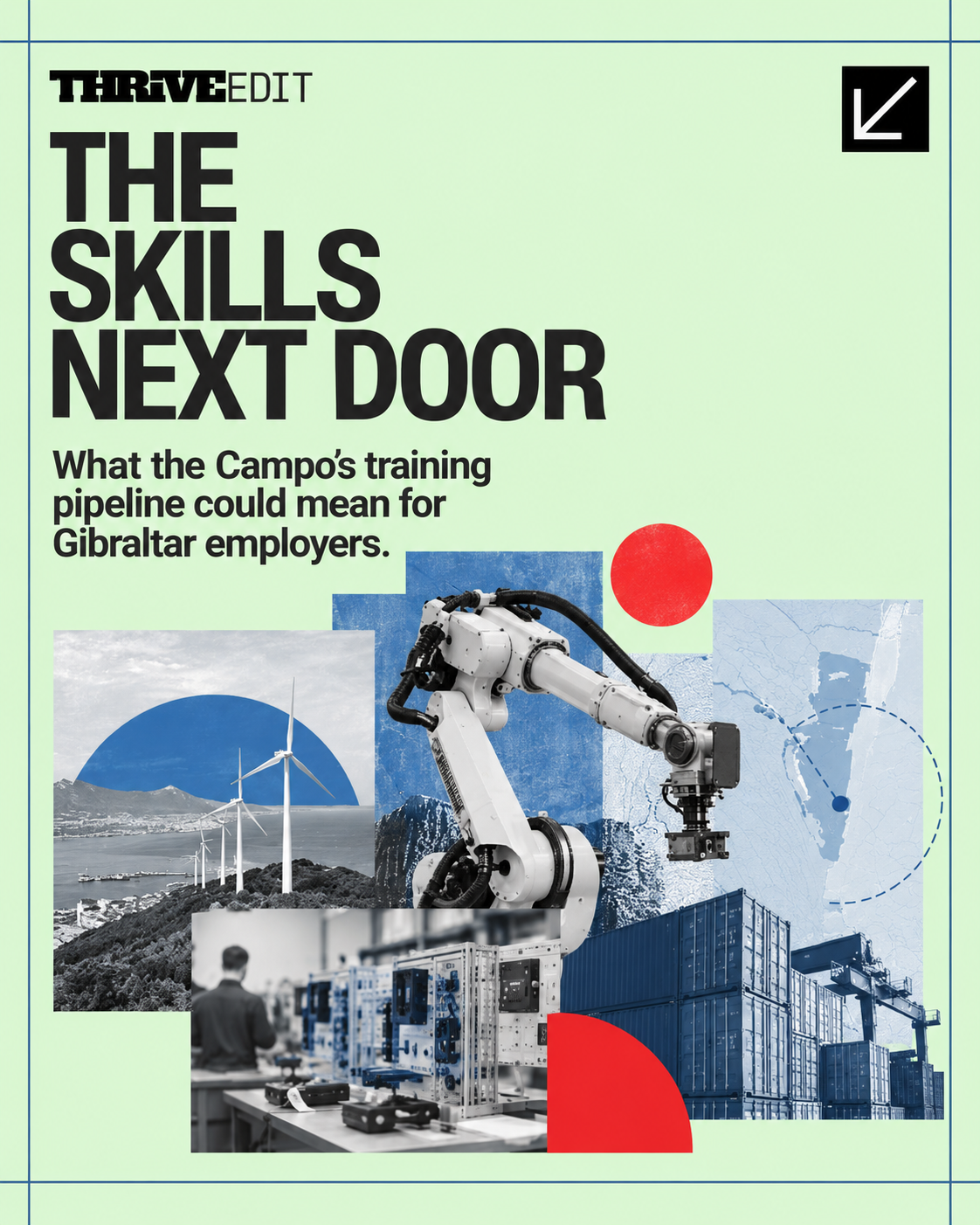

Investment in automation, logistics, tourism and green technology across the Campo de Gibraltar is reshaping the regional skills base. Here’s what Gibraltar employers should watch.

Imported goods around the Treaty changeover? It is worth going back through July’s paperwork. HM Customs has introduced a refund process for qualifying consignments that had already started their journey to Gibraltar before 15 July but were cleared afterwards.

Clocked out in August? Good for you. Thrive EDIT Editor David Revagliatte rounds up the Gibraltar business stories worth clocking back into. August is supposed to be the month when Gibraltar collectively eases off the accelerator. Judging by the news cycle, nobody told 2026. The first full month of life under the new Treaty arrangements brought a mixture of early optimism and very real teething problems for businesses. New employment rules landed, a pensions deadline crept closer, one of Gibraltar's most important airlines changed hands and a major local bank announced job cuts.

Last year's debut GIBLDN conference drew a full house of around 400 people in London. Now Gibraltar is taking the show on the road. GibLink heads to Marbella, Manchester and London this autumn, with sponsorship packages starting from £500 and opportunities ranging from brand visibility and guest tickets to on-stage participation.