

 Gibraltar Federation of Small Businesses


 Gibraltar Federation of Small Businesses


How will the UK Budget impact Gibraltar?
“Devastating” is how the Minister for Justice, Trade and Industry described the potential effect of any significant increase in UK gambling duty on 12 November this year. Well, now those duties have doubled. So is Gibraltar facing the devastation the Minister previously warned about? By yesterday, in his GBC interview, the Minister was dialling down the rhetoric somewhat, saying instead that he would “rather not make any value judgement” and that the Government needed to sit down with industry.
He said that tax revenues for the forthcoming year were expected to be a record, and that what the Government must now consider is the potential impact on tax revenues in future years. The Minister shied away from making any predictions about the loss in revenue that Gibraltar will suffer as a result of a 40% increase in UK gaming duties, having previously indicated that a 50% increase would result in a £133 million loss to the Gibraltar Exchequer (said GBC).
So what does this mean for Gibraltar and the state of Government finances?
In 2023–2024, the budget surplus was £1.9 million. The projected surplus for 2024–2025 was £9.78 million. Any significant decrease in tax revenues would put these surpluses at risk and, on the figures currently being discussed publicly, would appear to suggest that we may be heading for deficit unless revenues do not fall as steeply as predicted or the Government is able to implement significant curbs on expenditure.
Overall, it is clear that the UK Budget is not good for Gibraltar’s economy and is a strong indication of tough fiscal decisions to come.
Residency Upside Gone?
For many weeks, the prediction had been that the Budget would include an increase in income tax, potentially triggering an exodus of high-net-worth individuals from the UK. Gibraltar had been viewed as a possible beneficiary of such an outflow. But in recent weeks, the mood music shifted away from income tax rises and, as confirmed yesterday, the Budget contains no such increases. It therefore seems that this potential upside for Gibraltar will not be delivered to the extent previously anticipated.
Could Gibraltar’s Budget Contain a few of these?
Other interesting parts of the Budget relate not to measures that will directly affect Gibraltar, but to the type of growth-focused policies the GFSB would very much welcome seeing introduced here in Gibraltar. These are measures aimed at increasing productivity, supporting entrepreneurship, and boosting investment, incentives which are much needed in Gibraltar, particularly as we enter a period of increased competition under the forthcoming Brexit agreement.
These interesting measures are as follows.
Business taxes
• There will be an expansion of entrepreneurial investment schemes and there will be a three-year stamp duty holiday on the purchase of shares in companies newly listed in the UK.
• Reeves is also launching a consultation on how to attract more entrepreneurs. “If you build here, Britain will back you,” she says.
• There will be a 40% allowance to allow businesses to write off more of their upfront investment costs.
• There will be permanently lowered business rates for 750,000 retail, hospitality and leisure businesses, paid for higher rates on properties worth more than £500,000, used by “warehouse giants”. There will be £4.3bn of support for properties that receive a large increase in their bill.
• Customs duty will apply to parcels of any value, to stop online retailers undercutting high street retailers on price.
Welfare and apprenticeships
• There will be funding to make sure that apprenticeships are free for small and medium-sized enterprises.
What happens now?
We can’t avoid the fact that Gibraltar now faces a very different landscape from the one many had anticipated only weeks ago. With UK gaming duties doubling and no corresponding rise in UK income tax to fuel relocations, the hoped-for upside has evaporated while the potential downside has grown sharper.
Gibraltar’s surpluses were already narrow and the figures discussed publicly point to a real possibility of falling into deficit unless revenues hold up better than expected or spending is brought firmly under control. The UK Budget does, however, showcase the kind of pro-growth measures the GFSB has long argued for, from investment incentives to SME-focused apprenticeship funding, and it may serve as a useful benchmark as Gibraltar prepares for increased competition under the forthcoming treaty.
If you want to stay ahead of these shifts and understand what they mean for your business, subscribe to Thrive Edit and get the week’s essential analysis delivered straight to your inbox.




Governments and geopolitical strategists use simulations to test what might happen when other players react. The same thinking can help businesses challenge assumptions, anticipate competitors and prepare for decisions before real money is on the line.

From Hong Kong to Abu Dhabi, Gibraltar is pursuing new industries and investors as part of a major economic diversification drive. Minister Nigel Feetham says the campaign is already generating business. The bigger question is how far those opportunities can spread through Gibraltar’s wider economy.

Gibraltar plans a new residency route for financially independent over-55s alongside a new business think tank announced at GibLink London.

New frontier lanes and discussions around a cross-border transport interchange raise questions about buses, workers, visitors and business connectivity.
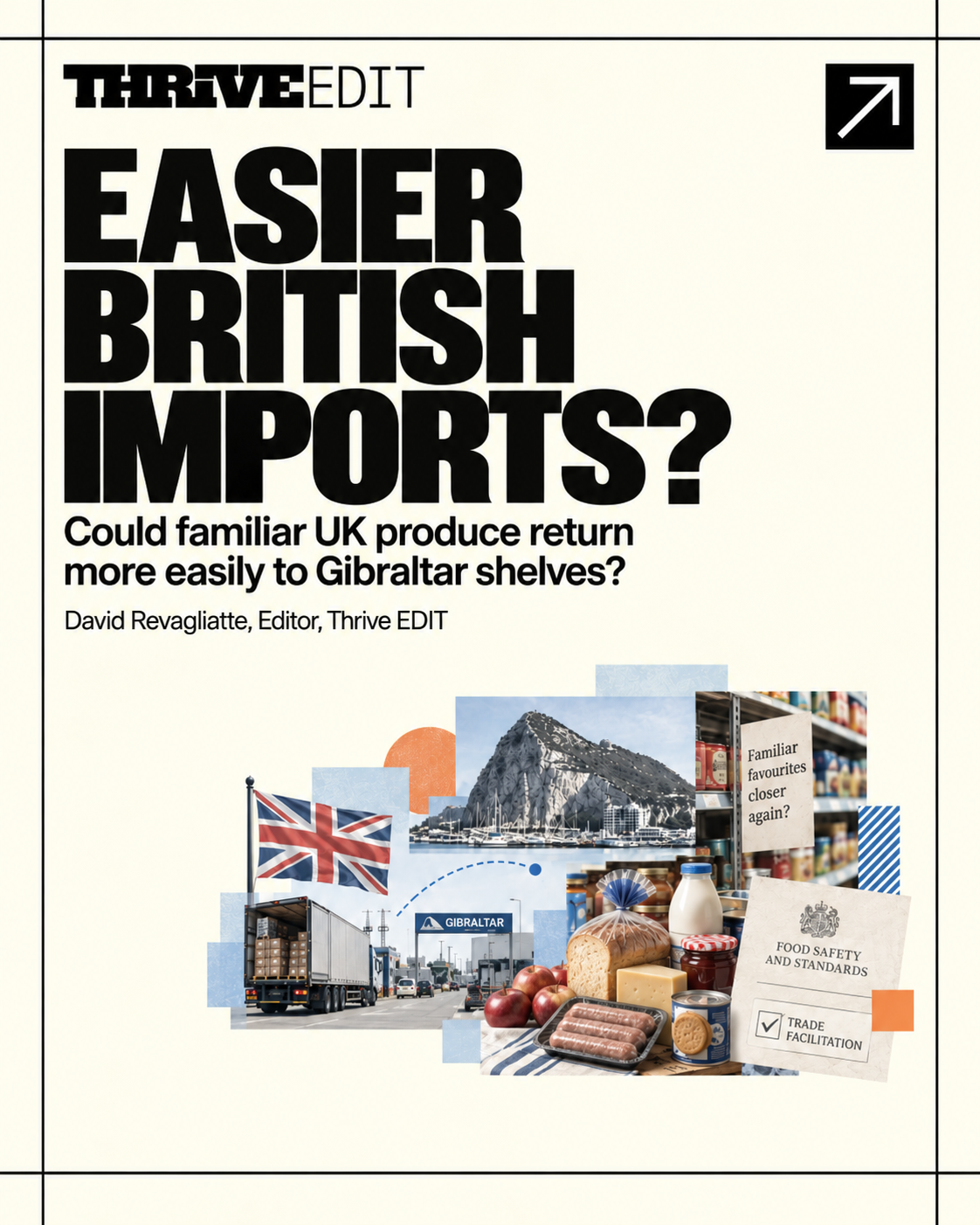
Could a future UK-EU food agreement make it easier for British produce to return to Gibraltar shelves? British produce has long been part of Gibraltar’s shopping experience; I wrote about it a couple of years ago, before we had a Treaty in place. From supermarket staples and fresh food to familiar household brands, we’ve spent […]